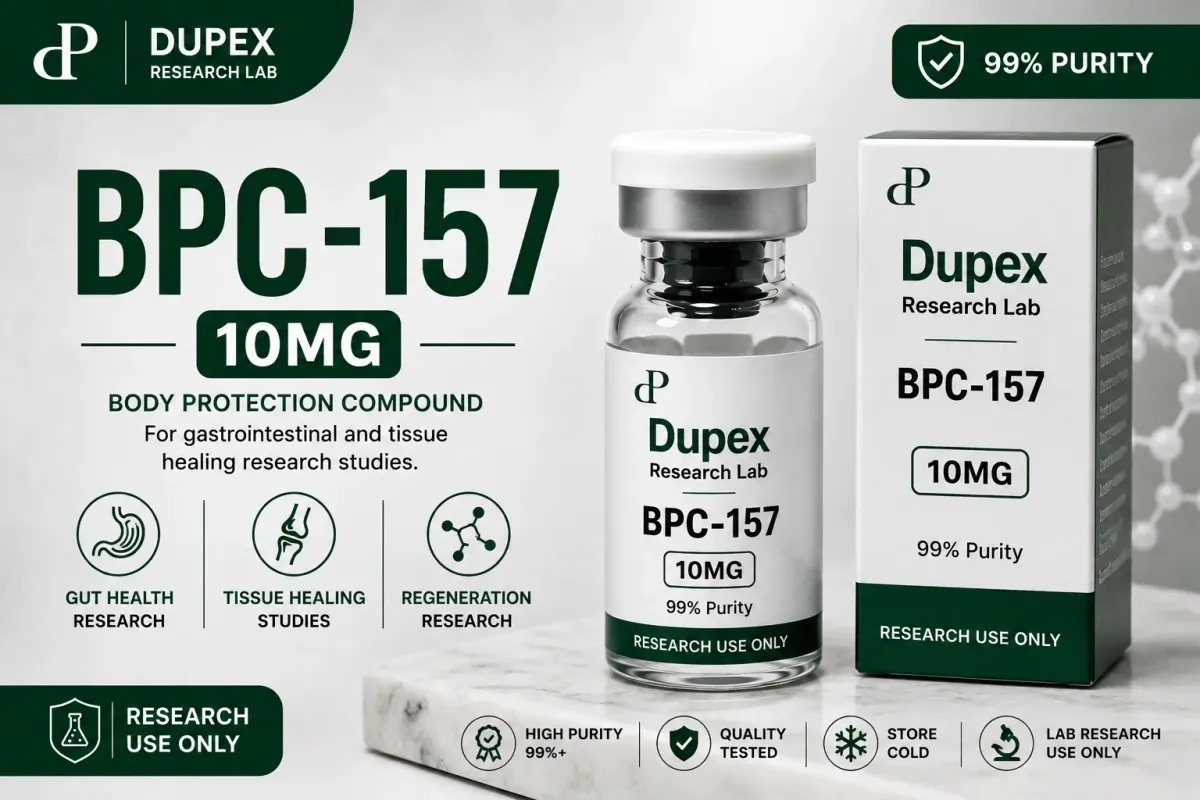
BPC-157 10MG for Gastrointestinal and Tissue Healing Research
BPC-157 10MG is becoming progressively recognized in research and the preclinical field for their potential in gastrointestinal tissue repair mechanisms, cellular regeneration, and recovery-related pathways. With the increasing global interest in peptides for regenerative applications in 2026, BPC-157 studies are mainly significant in research efforts focused on tendon recovery, muscle repair, signaling to the gut, angiogenesis and the modulation of inflammatory responses. This 10mg research formulation is intended for controlled lab and investigational purposes where consistency, purity and research grade quality are critical.
Scientists working on peptide based regeneration pathways are still investigating the potential effect of BPC-157 on nitric oxide signaling, the activation of fibroblasts, vascular regeneration, collagen production, and gastrointestinal tissue protection.
What Is BPC-157 and What Is It Used for in Research?
BPC-157 is a synthetic peptide or short stretch of protective protein that is naturally found within gastric compounds. It is mainly investigated in research systems for gastrointestinal healing pathways, connective tissue repair, supporting angiogenesis, signaling muscle recovery, and mechanisms of cell regeneration.
The scientific community is still studying it in experimental models regarding its potential applications in:
Tendon recovery research
Muscle repair pathways
Gastrointestinal tissue protection
Recovery optimization studies
Connective tissue regeneration
Inflammatory response modulation
Why BPC-157 Research Is Growing Rapidly in 2026
The field of peptide research has moved dramatically towards the recovery and regeneration of peptide type compounds, and peptides used as signaling agents in the biological world. BPC-157 is unique in that it is also being studied in multiple systems, not just one system.
For modern peptide laboratories a primary focus is on:
Tissue regeneration pathways
Signaling research for gut health
Recovery-support investigations
Connective tissue healing models
Cellular communication peptides
Vascular repair mechanisms
BPC-157 corresponds very well with these new trends in research with regard to processes of healing that include injured tissues, vascular system, and inflammatory mediators.
The Science Behind BPC-157 Tissue Healing Research
BPC-157's ability to impact multiple biological repair systems is one of the reasons for its considerable scientific interest. Different from only targeting one single pathway, studies have indicated that it could affect several pathways of recovery and tissue adaption.
Angiogenesis and Vascular Recovery Research
Scientists have discovered that BPC-157 can maybe aid in the development of new blood vessels. In tissue repair, it is essential that the tissue becomes vascularized to get oxygen, nutrients and cell signals into damaged tissue to repair it well.
Researchers are continuing to investigate the role BPC-157 might play in the pathways leading to vascular repair and nourishment of the local tissue.
Collagen and Connective Tissue Studies
Collagen organization and activity of fibroblasts are extremely important to connective tissues like tendons and ligaments. Peptides that have the potential to modulate collagen-associated pathways for regeneration are often tested in research models of tendon healing.
In areas of tendon recovery, ligament repair process, joint support research and connective tissue regeneration models, BPC-157 has grown in relevance of its studies. These areas continue to be critical in sports recovery science and peptide research pertaining to rehabilitation.
Gastrointestinal Integrity and Gut Health Research
The gastrointestinal (GI) tissue protection is among the main scientific interests of BPC-157. Its role in supporting gut lining integrity and the repair process of digestive tissues are still being studied.
Continuous investigations often include the study of gastric mucosal protection, models of intestinal repair, regeneration of digestive tissue, inflammatory pathways in the gut and support of the gastrointestinal barrier. This correlation with digestive studies is part of the reasons why the peptide is known to be a “Body Protection Compound”.
BPC-157 and Recovery Optimization Research
The field of recovery science is one of the most dynamic branches of peptide science. Researchers working on recovery mechanisms are ongoing to explore the potential for recovery signaling peptides following physical stress or injury models.
When studying BPC-157, researchers investigate muscle recovery signaling, soft tissue healing mechanisms, inflammatory balance research, and optimization of recovery time mechanisms. Due to its extensive investigation spectrum, the peptide is still valid for multi-system recovery studies rather than for research applications.
Why BPC-157 is different from the other research peptides
The majority of peptides used in regenerative medicine are very specific and target particular biological functions such as the muscle growth signaling, metabolic regulation, etc. Unlike other forms, BPC-157 may work on multiple pathways including gastrointestinal, connective tissue, vascular repair and recovery-related signaling networks in a manner that is not documented in the research.
This broad investigational scope has helped propel its rise in popularity in the world of peptide science and recovery focus research labs.
Why Research Quality and Purity Matter
Consistency and purity are critical when choosing research peptides for reliable investigations. For a laboratory doing more involved research on regeneration, the quality of the peptide source used is of paramount importance.
Research-grade BPC-157 formulations are valued because researchers prioritize:
High peptide purity standards
Stable lyophilized peptide preparation
Reliable manufacturing consistency
Accurate research dosing protocols
Proper peptide storage conditions
Batch-to-batch quality verification
Improved research reproducibility
Enhanced peptide stability for long-term studies
With the progression of 2026, the peptide industry is becoming more competitive, and quality assurance is playing a significant role in the reliability of research, consistency of data and accuracy of experiments.
Emerging Areas of BPC-157 Research
A 10mg format is often chosen when the study is a research project, requiring controlled laboratory studies, and extended periods for experimentation. This concentration is often used for studies like tissue recovery pathway analysis, gastrointestinal healing studies, and studies of regenerative signaling over a longer period of time.
Because of its versatility it is particularly appropriate for laboratories which research a variety of healing and rehabilitation processes at once.
FAQs
Is there any tissue healing research for BPC-157?
BPC-157 has been extensively studied for tendon, ligament, muscle and connective tissue healing processes. Its possible contribution to regeneration signaling and regeneration-related mechanisms is still under investigation.
What's the connection between BPC-157 and gut health?
Many studies center on intestine protection of gastrointestinal lining, digestive pathways to recovery, and protective sequences of gastric protein, hence the peptide comes from it.
Does BPC-157 have studies for recovery optimization?
Yes. The peptide BPC-157 is often investigated in recovery research due to its attachment with tissue adaptation, inflammatory regulation, and regenerative signaling.
What is the difference between BPC-157 and other peptides?
Unlike peptides which target individual mechanisms, BPC-157 is studied in several different biological areas, such as gastrointestinal, connective, vascular and recovery signaling systems.
What makes BPC-157 research grade?
Consistency and purity are the key factors in the accuracy of research. Peptide preparation that is of high quality allows for maintaining reliable investigational conditions and reproducible laboratory outcomes.
Final Note
BPC-157 10MG remains one of the most studied peptides used in the field of regenerative medicine today. The versatile applications of peptides in gastrointestinal protection research, tissue regeneration processes, connective tissue healing, and regenerative signaling studies underscore a broader trend of advancing peptide-based recovery science in 2026.
The study of peptides continues to grow, with researchers seeking those with emerging applications across the biological sciences, and BPC-157 stands out as a key player in the new era of regenerative and healing scientific research. To meet the high demand for research peptides of superior quality, Dupex Research Peptide is dedicated to supplying research peptides for advanced scientific applications and investigations.
